History of St Yeghiche Church
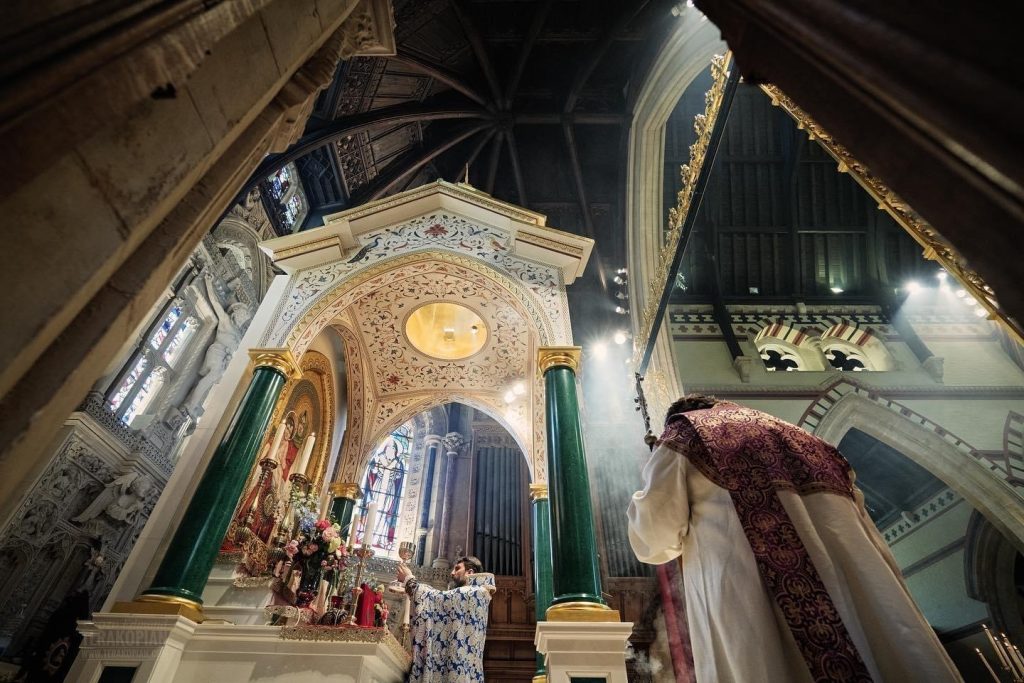
St Yeghiche Armenian Church (Սdelays Եdelays delays) is the largest church of the Armenian Apostolic Church in Great Britain with seating capacity of 1000. It is located in Cranley Gardens, Kensington, London. The church was built as St. Peter’s Anglican Church and was closed c.1973, the building was purchased in 1998 by benefactors Vatche and Tamar Manoukian and after extensive renovation the church was consecrated by His Holiness Karekin II Supreme Patriarch and Catholicos of All Armenians on 10th June 2001.
The Armenian Church is pre-eminently a national Church, through which all the cultural activities are channelled. Faith helps to keep the moral of the people high through all the troubles of its post – First World War dispersal to every corner of the globe. The Church is seen as that, which unites all Armenians, whether or not they go to services. The mother country is now split up between Turkey, Iran, and independent Armenia. Mount Ararat, the landing stage for Noah’s Ark, stood at the heart of this nation, which adopted Christianity before any other, in 301 under king Tiritades III. The cathedral at Etchmiatzin, built of Ararat granite, has stood for over 1700 years.
There are no icons or statues in Armenian churches. Murals, alter paintings, or stained glass is fine, but the cross, such as that at St Yeghiche, must be plain with no representation of human form like a western crucifix. At the altar, twelve candles are set burning, representing the twelve apostles, and beside the Cross at St Yeghiche is a large picture of the Virgin and Child. The sacrament is given in front of the altar to the communicant who is barefoot or slippered.
Armenian chants and hymns are most impressive, some dating from the 3rd century. They bear some relationship to Gregorian Chants. St Yeghiche has a twenty – voice Choir, strengthened with additional voices on high Holy Days. The church also possesses an immense organ, the second largest in the country. The word for the Armenian hymnal is the Sharakan, which translates as “row of gems”.
Our Patron Saint – St. Yeghiche (415-475 A.D.)
Nightingale, voice of the night, little soul of the roses,
Ghevond Alishan (The Nightingale of Avarayr)
Friend of all mournful hearts that with sorrow are sighing!
Sing, little nightingale, sing me a song from that hillock,
Sing with my soul of Armenia’s heroes undying!
St. Yeghiche was one of the youngest disciples of Sts. Mesrop Mashtots and Sahag Partev. He is known for his many achievements that have enriched the cultural treasury of the Armenian Nation.
After a short period of study in Armenia, Yeghiche was sent to Alexandria in around 435 for enhancement of his education. As a student he was already singled out for his profound knowledge of both the early Hellenistic culture, as well as the teachings of the fathers of the Church.
Upon his return to Armenia, St. Yeghiche became the personal scribe of General Vardan Mamikonian. Together with Vardan and his soldiers Yeghiche was involved in the famous battle of Avarair in 451 A.D. He soon composed a book titled ‘A History of Vardan and the Armenian War’ in which he beautifully narrated about the courage of the Armenian warriors and their determination to preserve their Christian Armenian identity. Inspired by this, St. Yeghiche wrote his famous phrase “Death, unanticipated, is death; death, anticipated, is immortality” which soon became a motto for many soldiers of the land of Armenia. He was named ‘the Nightingale of Avarayr’ by a 19th c. prominent poet and historian Ghevond Alishan, who dedicated an entire poem to St. Yeghiche and the other holy martyrs of Avarayr.
After the invention of the Armenian alphabet by St. Mesrop Mashtots, when all the tools were provided for creation of the Armenian literature, the holy translators of the 5th century started translating the Bible and the works of the fathers of the Church. Based on these translations many of the disciples of Mesrop Mashtots and Sahag Partev wrote their own works, thus laying the foundation of the Armenian unique literature.
When the war with the Persians was over, St. Yeghiche embarked on a profound study of the Holy Scripture and as a result of his studies, he composed commentaries on Genesis, Joshua, Judges etc. He also produced some other outstanding works of both pastoral and doctrinal nature, such as, ‘On The Feast of Baptism of Christ’, ‘On the Feast of Transfiguration’, ‘On the Lord’s Prayer’, ‘On The Judgment and The Second Coming’, ‘On Remembering The Dead’ etc.
The oldest extant manuscript containing St. Yeghiche’s ‘History of Vardan’ is dated to the 12th century. The two best editions of this work were published first, in 1826 in Venice by the Mechitarist fathers, and the second, in 1957 in Yerevan by Y. Ter-Minasian.
Being acquainted with the works of the early authors of the church and using their works as a base for his own research St. Yeghiche elevated the studies of the Bible and Christian tradition in Armenian to a whole new level. In his commentaries as well as pastoral works St. Yeghiche has shown his extremely high intellect and the in-depth knowledge of the main theological traditions of the time. Alongside Armenian, many other languages, e.g. Greek, Syriac, Persian etc., were taught in the schools established by St. Yeghiche.
Every year the Armenian Apostolic Holy Church commemorates St. Yeghiche together with the other Holy Translators of the Church. His feast falls on the Saturday preceding the fifth Sunday of the Holy Cross.
V. Rev. Fr. Garegin Hambardzumyan