Chrismation / Confirmation with the Holy Oil
This Sacrament brings a new “Pentecost” to each individual, since it makes the newly baptized to receive the Holy Spirit.
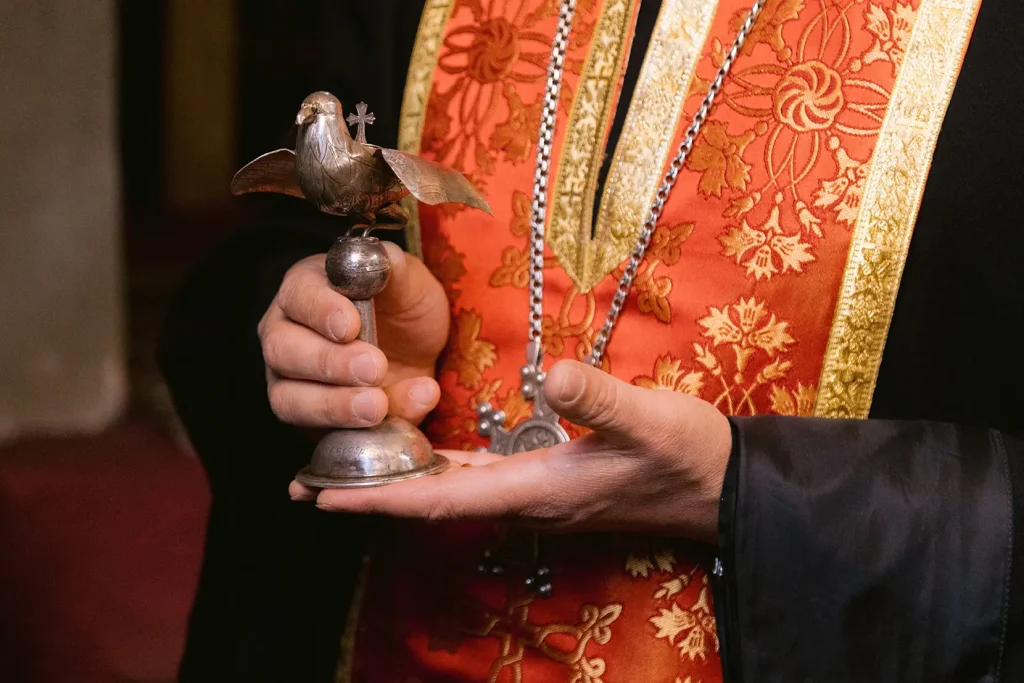
In the Armenian Church it is performed immediately after the Baptism with the ointment of the Holy Miuron. It symbolizes the coming of the Holy Spirit in the form of a dove upon Jesus while receiving baptism by John the Baptist. Its practice is originated from the Apostles who placed their hands on the newly baptized for them to receive the Holy Spirit, as we read in the Acts of the Apostles: “They had only been baptized in the name of the Lord Jesus. Then they laid hands on them, and they received the Holy Spirit” (8: 16-17); “And when Paul had laid hands on them, the Holy Spirit came upon them, and they spoke with tongues and prophesied.” (19: 6).
Whereas Baptism cleanses the person from his original sin, Confirmation empowers him with the gifts of the Holy Spirit throughout his life; it enlightens the person’s spiritual abilities, taking him out of darkness and leading him to a life of hope and godliness. Unlike the Roman Catholic Church, which later in the 13 th century, deviating from the original tradition, postponed the Confirmation of the child up to a certain age, keeping the Baptism as it was, the Armenian Church believes that the child should receive the life-giving gifts of the Holy Spirit in life as soon as possible, before something happens to the child. It is obviously contradictory to baptize the infant while the infant is a baby, and to postpone his/her confirmation to the age of 12 to 14, arguing that the grown up will understand the Sacrament of Confirmation. The same is not being applied however to the Sacrament of Baptism. In my opinion I still think there is some wisdom in the Catholic tradition. The Holy Oil is the means by which several parts of the child’s body are anointed by the priest, by dipping his thumb in the Oil and making the sign of the cross each time with the proper formula on each part of the body. He in fact “seals in the name of Jesus Christ” the forehead, the eyes, the ears, the nose, the lips, the heart, the hands, the back and the feet. For each a specific power is asked for a life-time defense and guidance, such as, for the forehead “immaculate gifts,” for the eyes “light of immortality,” for the ears “hearing divine commandments,” for the nose “smelling the sweetness of life,” for the lips “controlling the words coming out of the mouth,” for the hands “accomplishing good deed and conduct,” for the heart “remaining firm in holiness where the Holy Spirit can be renewed,” for the back “being helmet of resistance against the evil,” for the feet “enabling to walk in life firmly to attain eternal life.”
In the Roman and the Anglican churches Confirmation is reserved for the bishops only, whose privilege it is to pronounce in the first person, saying: “I confirm thee,” leaving the impression as if the source of the gifts of the Holy Spirit is the bishop himself. In the Armenian Church, as mentioned above, all Sacraments and blessings are done in the third person and in the passive tense, ascribing the privilege to the Lord Jesus Christ alone. In the case of Confirmation, for example, says the priest: “This divine seal in the name of Jesus Christ may enlighten your eyes,” and so forth. The third Sacrament of Holy Communion follows, as the child is carried up on the Holy Altar where he/she worships with the priest for the first time before receiving the Communion.
There is one final note regarding the 40th day of the birth of the child. It is customary and very common that parents bring their children on the 40th day to present them to the Church, following the Presentation of Jesus to the Temple when he was 40 days old. The Book of sacraments of the Armenian Church has a special canon for this, with the instruction that it is done after the Baptism and Confirmation, and not before, since those Sacraments are meant to be performed within the first 8 days, or at least before the 40 th day of the birth, so that on the 40 th day the baptized and confirmed child is readily presented to the church. This, as we see almost every week, is done in reverse, thinking that it would be too early to baptize the child at the early age of a few weeks.